
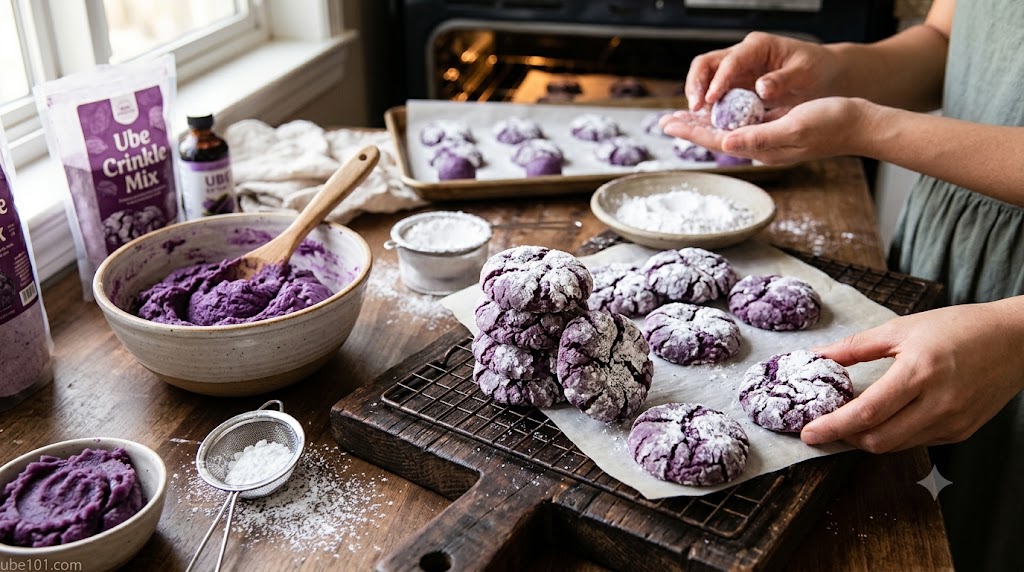
The first ube crinkle cookie I ever ate came from a Filipino coworker who brought a batch to the office. She warned me that they looked strange. She was right. They were bright purple underneath a crackled layer of powdered sugar, like something from a fantasy novel. Then I bit into one. Soft, chewy, lightly sweet, with a warm vanilla-nutty flavor that I had never experienced in a cookie. I asked for the recipe before I finished the first one.
Ube crinkles are one of the great unsung success stories of Filipino-American baking. Before ube lattes, ube ice cream, and ube everything else, there were ube crinkle cookies showing up at Filipino holiday gatherings, potlucks, and bakery cases. At Ube 101, we consider them the gateway cookie for the entire ube movement in America.
Ube crinkles are soft, chewy cookies made with ube halaya (purple yam jam) and ube extract, rolled in powdered sugar before baking. As the cookies bake, the exterior cracks and the powdered sugar coating creates the signature “crinkle” pattern. The result is a visually striking purple cookie with a tender center, a vanilla-nutty flavor from the ube, and a light sweetness that keeps you reaching for another one.
What Are Ube Crinkle Cookies?
Ube crinkle cookies are a Filipino adaptation of the classic American crinkle cookie. The original chocolate crinkle cookie is credited to Helen Fredell of St. Paul, Minnesota, who developed the recipe in the 1940s or 1950s. The concept is simple: a soft, fudgy cookie dough rolled in powdered sugar before baking, creating cracks in the white coating as the cookie spreads in the oven.
Filipino bakers took that concept and replaced the chocolate with ube. Instead of cocoa powder and chocolate, the dough uses ube halaya (the thick, sweet jam made from purple yam) and ube extract for color and flavor. The result is a cookie that is uniquely Filipino while using a familiar American cookie format.
In the Philippines, crinkle cookies (both chocolate and ube versions) are a common sight at bakeries, holiday tables, and gift boxes. They are especially popular around Christmas and during fiestas, where home bakers produce large batches for family and neighbors. The ube version has become so popular that it has largely eclipsed the original chocolate crinkle in many Filipino-American households.
How Ube Crinkles Helped Start the Ube Movement
Ube crinkles deserve credit as one of the earliest foods that introduced non-Filipino Americans to ube flavor. Before Starbucks launched ube lattes and Trader Joe’s started stocking ube ice cream, ube crinkles were already crossing cultural boundaries at school bake sales, office potlucks, and farmers’ markets in cities with significant Filipino-American populations.
The visual impact played a huge role. A tray of ube crinkles at a potluck is impossible to miss. The deep purple cookies with white powdered sugar cracks look like nothing else on the table. That visual curiosity drove people to try them, and the flavor kept them coming back.
Food bloggers and Instagram accounts started documenting ube crinkles as early as 2015-2016, around the same time that ube was starting to gain broader attention in American food media. Blogs like Hummingbird High, Kawaling Pinoy, and The Unlikely Baker published detailed ube crinkle recipes that spread beyond Filipino cooking communities.
By 2018-2019, Filipino bakeries in New York, Los Angeles, and the San Francisco Bay Area were selling ube crinkles to diverse customer bases. Shops like Purple Dough in Woodside, Queens, became known specifically for their ube cookies and pastries. The success of these small businesses helped normalize ube as a flavor that belonged in American bakeries, not just Filipino ones.
Ube Crinkles Recipe (Tested and Reliable)
This recipe makes approximately 24 to 30 cookies, depending on size. The key ingredients are ube halaya and ube extract, which you can find at Filipino grocery stores or order online.
Ingredients:
2 cups all-purpose flour 1 teaspoon baking powder 1/4 teaspoon salt 1/2 cup (1 stick) unsalted butter, softened 3/4 cup granulated sugar 1/2 cup ube halaya (purple yam jam) 1 teaspoon ube extract 2 large eggs 1 teaspoon vanilla extract 1/2 cup powdered sugar (for rolling)
For buying ube halaya and ube extract online, check our best ube products guide, which includes links to recommended products with real Amazon availability.
Instructions:
Whisk together the flour, baking powder, and salt in a medium bowl. Set aside.
In a large bowl, beat the softened butter and granulated sugar together until light and fluffy, about 2 to 3 minutes with an electric mixer. Add the ube halaya and beat until fully combined. The mixture will look purple and slightly lumpy, which is normal.
Add the eggs one at a time, beating after each addition. Add the ube extract and vanilla extract. Mix until everything is uniform in color.
Gradually add the flour mixture to the wet ingredients, mixing on low speed until just combined. Do not overmix. The dough will be sticky and soft.
Cover the bowl with plastic wrap and refrigerate for at least 2 hours, or overnight. This step is not optional. The dough needs to firm up in order to roll into balls. Skipping this step means the dough will stick to your hands and the cookies will spread too much during baking.
When ready to bake, preheat your oven to 350 degrees F (175 degrees C). Line baking sheets with parchment paper.
Place the powdered sugar in a small bowl. Scoop the dough into 1-inch balls (about 1 tablespoon each). Roll each ball generously in powdered sugar until fully coated. Place on the prepared baking sheets, spacing them about 2 inches apart.
Bake for 10 to 12 minutes. The cookies should be set at the edges but still soft in the center. The crinkle pattern will form as the cookies expand and the powdered sugar coating cracks. Do not overbake. These cookies are meant to be soft and chewy, not crispy.
Let the cookies cool on the baking sheet for 5 minutes before transferring to a wire rack.

Tips for the Best Ube Crinkles
Chill the dough thoroughly. This is the most common place where ube crinkle recipes go wrong. If the dough is not cold enough, the balls will flatten too much in the oven and the crinkle pattern will not form properly. If the dough is still too sticky after 2 hours, give it another hour in the refrigerator.
Use real ube halaya. The halaya provides both flavor and moisture. Ube extract alone will give you color but not much actual ube flavor. The best ube crinkles use both halaya for flavor and a small amount of extract for color intensity.
Do not skip the powdered sugar. The powdered sugar is not just decoration. It creates the surface texture that cracks during baking. Without it, you get a purple cookie but not a crinkle cookie.
Do not overbake. Pull the cookies out when the edges are set but the centers still look slightly underdone. They will continue to firm up as they cool. Overbaked ube crinkles lose their signature chewy texture and become dry and crumbly.
Add purple food coloring if you want intense color. Natural ube loses some of its color intensity during baking. If you want the vivid purple that looks great in photos, add a few drops of purple food coloring to the dough. This is purely cosmetic and does not affect flavor.
How to Store Ube Crinkles
Ube crinkles keep well at room temperature for up to 5 days if stored in an airtight container. The chewy texture holds up surprisingly well, and some people feel the cookies taste even better on day two, after the flavors have melded overnight.
For longer storage, freeze the baked cookies in a single layer on a baking sheet, then transfer to a freezer bag once solid. They keep for up to 3 months in the freezer. Thaw at room temperature for 20 to 30 minutes before eating.
You can also freeze the unbaked dough balls. Roll them in powdered sugar, place on a baking sheet, freeze until solid, then transfer to a freezer bag. Bake directly from frozen at 350 degrees F, adding 2 to 3 minutes to the baking time.
Where to Buy Ube Crinkle Cookies
If baking is not your thing, several Filipino bakeries and online shops sell ready-made ube crinkles.
In metro areas with significant Filipino-American communities (Los Angeles, San Francisco Bay Area, New York, Chicago, Las Vegas, and Honolulu), Filipino bakeries often carry ube crinkles. Purple Dough in Woodside, Queens is known specifically for ube baked goods.
Online, small Filipino bakeries ship ube crinkles nationwide through platforms like Etsy and Goldbelly. Prices vary widely (from around $15 to $35 per dozen depending on the bakery and shipping), so check reviews before ordering.
For making them yourself at home, you will need two key ingredients that most American grocery stores do not carry: ube halaya and ube extract. Both are widely available on Amazon and at Filipino grocery stores like Seafood City and Island Pacific.
Ube Crinkles vs Chocolate Crinkles
Since ube crinkles are a variation on the classic chocolate crinkle, comparing the two helps set expectations for people trying ube crinkles for the first time.
| Feature | Ube Crinkles | Chocolate Crinkles |
|---|---|---|
| Color | Deep purple | Dark brown |
| Flavor | Vanilla-nutty, mildly sweet | Rich chocolate, bittersweet |
| Texture | Soft, chewy, slightly dense | Fudgy, brownie-like |
| Sweetness level | Moderate | Moderate to high |
| Key ingredient | Ube halaya + ube extract | Cocoa powder + chocolate |
| Cultural origin | Filipino adaptation | American original (1940s) |
The ube version is lighter in flavor intensity than the chocolate version. If you love chocolate crinkles, do not expect the same richness from ube crinkles. What ube crinkles offer instead is a unique flavor profile that is hard to find in any other cookie: warm, nutty, gently sweet, with a vanilla undertone that makes you want another one.
The Bottom Line
Ube crinkles are one of the most accessible ways to experience Filipino ube flavor at home. They are simple to make, visually stunning, and they deliver a flavor that most non-Filipino audiences have never encountered in a cookie. If you are looking for a baking project that will impress people and introduce them to something genuinely different, ube crinkles are where you start.
For a deeper look at the ingredient behind these cookies and where to source the best ube products, explore the full Ube 101 guide library.
SEO Metadata
Title tag: Ube Crinkles: Recipe, History, and Tips Meta description: Ube crinkles are soft purple Filipino cookies rolled in powdered sugar. Here is a tested recipe, history, and baking tips. URL slug: ube-crinkles Excerpt: Ube crinkles are the cookie that introduced millions of Americans to ube. Here is a tested recipe, the history behind the purple cookie, and tips for getting the crinkle pattern right.
References:
- Kawaling Pinoy. “Ube Crinkle Cookies.” kawalingpinoy.com.
- Hummingbird High. “Ube Crinkle Cookies.” hummingbirdhigh.com.
- The Unlikely Baker. “Ube Crinkles.” theunlikelybaker.com.
- Wikipedia. “Crinkle cookie” (history and Helen Fredell attribution). wikipedia.org.
- Kitchen Confidante. “Ube crinkle cookies recipe.” kitchenconfidante.com.
- Sandy Eats. “Crinkle cookies origin and cultural significance.” sandyeats.com.
Често задавани въпроси
What are ube crinkles?
Ube crinkles are soft, chewy cookies made with ube halaya (purple yam jam) and ube extract, rolled in powdered sugar before baking. As they bake, the surface cracks to create a distinctive purple-and-white crinkle pattern. They are a Filipino adaptation of the classic American crinkle cookie.
What do ube crinkles taste like?
Ube crinkles taste mildly sweet with a warm vanilla-nutty flavor and a subtle earthiness from the ube halaya. The texture is soft and chewy. They are less intensely flavored than chocolate crinkles but more complex and unusual.
Can I make ube crinkles without ube halaya?
You can, but the results will be disappointing. Ube extract alone gives color but very little flavor. Ube halaya provides both the characteristic ube taste and the moisture that makes the cookies chewy. For best results, use both halaya and extract.
Where can I buy ube halaya for ube crinkles?
Ube halaya is available at Filipino grocery stores (like Seafood City and Island Pacific) and on Amazon. Common brands include Good Shepherd, Giron Foods, and Bulacan brand. Check our best ube products guide for specific product recommendations.
How long do ube crinkles last?
Ube crinkles keep for up to 5 days at room temperature in an airtight container. They can be frozen for up to 3 months. The chewy texture holds up well during storage, and some bakers prefer the flavor on day two after overnight resting.
Why are my ube crinkles flat?
Flat ube crinkles usually mean the dough was not chilled long enough before baking. The dough needs at least 2 hours in the refrigerator to firm up. If it is still sticky after 2 hours, chill it longer. Room-temperature dough will spread too much in the oven.
Can I freeze ube crinkle dough?
Yes. Roll the dough into balls, coat them in powdered sugar, freeze on a baking sheet until solid, then transfer to a freezer bag. Bake directly from frozen at 350 degrees F, adding 2 to 3 minutes to the standard baking time.
Are ube crinkles a Filipino food?
Yes. Ube crinkles are a Filipino adaptation of the American chocolate crinkle cookie, created by replacing cocoa and chocolate with ube halaya and ube extract. They are widely popular in the Philippines and among Filipino-American communities.
Why did my ube crinkles lose their purple color after baking?
Natural ube halaya loses some color intensity during baking due to heat. This is normal. If you want a more vivid purple, add a few drops of purple food coloring to the dough. This does not affect the flavor.
How are ube crinkles different from regular crinkle cookies?
Regular (chocolate) crinkle cookies are fudgy and rich with a deep chocolate flavor. Ube crinkles are softer and chewier with a lighter, vanilla-nutty flavor. The main visual difference is the purple color versus brown. Both use the same powdered-sugar-coating technique to create the crinkle pattern.