
This article is not available in this language yet
We haven't translated this guide into your selected language yet, but you can read the full original article in English.
Read Article in EnglishDomande frequenti
Where does ube originally come from?
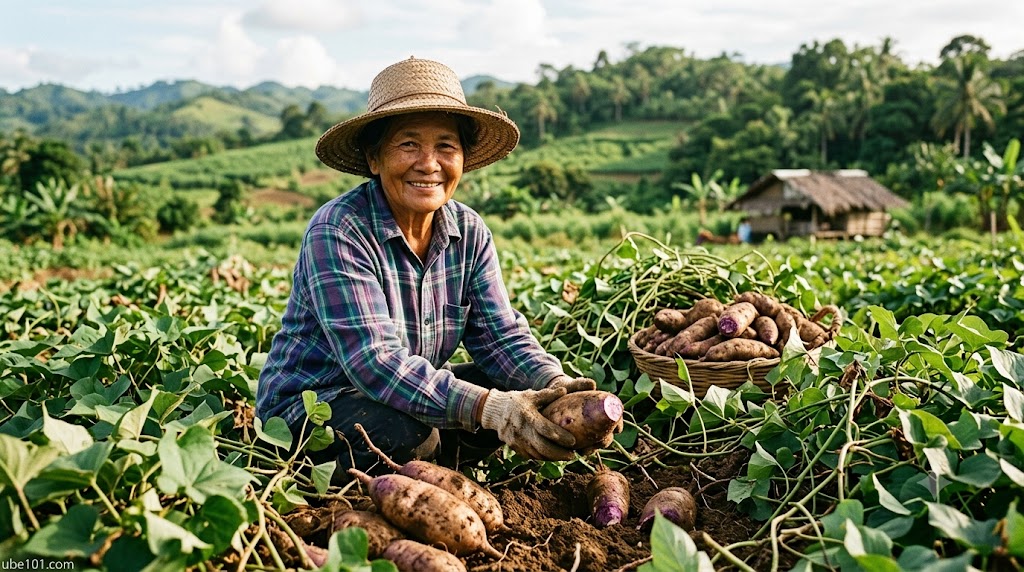
Ube (Dioscorea alata) is native to Southeast Asia and the Pacific Islands. The Philippines is one of its primary centers of cultivation, where it has been grown for thousands of years. The word "ube" comes from Tagalog and traces back to the Proto-Austronesian term *qubi*.
Is ube only found in the Philippines?
No. Dioscorea alata grows across Southeast Asia, the Pacific Islands, and parts of Africa. The Philippines is not the only country that cultivates it, but it is one of the primary sources and has the deepest culinary tradition around the ingredient.
What does ube taste like?
Ube has a mildly sweet, nutty, vanilla-like flavor with a gentle earthiness. The flavor is subtle in raw form and develops fully when ube is cooked into halaya with coconut milk, condensed milk, and butter.
Why is ube purple?
The purple color comes from anthocyanins, a class of antioxidant pigments also found in blueberries and purple cabbage. These pigments are naturally present in the flesh of the tuber and become more intense with certain varieties and growing conditions.
What is ube halaya?
Ube halaya is a traditional Filipino jam made from mashed purple yam cooked with coconut milk, evaporated milk, condensed milk, butter, and sugar. It is the base ingredient for most Filipino ube desserts, including cakes, ice cream, and pastries.
How much ube does the Philippines produce?
According to the Philippine Statistics Authority, national ube production was approximately 12,483 metric tons in 2025, down from over 14,000 metric tons in 2021. The decline is caused by planting material shortages, climate impacts, and fragmented smallholder farming.
Does the Philippines export ube?
Yes. In 2025, the Philippines exported approximately 1.7 million kilograms of ube and ube-based products, valued at around $3 million. Major export destinations include the United States, Canada, South Korea, and parts of Europe.
What is kakanin and how does ube fit in?
Kakanin refers to traditional Filipino rice cakes and sweets. Ube is a common flavoring and coloring ingredient in many kakanin preparations, adding its characteristic purple color and gentle sweetness to these traditional treats.
Is ube the same as taro?
No. Ube (Dioscorea alata) and taro (Colocasia esculenta) are completely different plants from different botanical families. Ube is naturally deep purple and sweet. Taro is naturally pale and has a mild, starchy flavor. They are not interchangeable.
Why is ube production declining in the Philippines?
The main factors are a shortage of planting material (farmers sell entire harvests rather than saving seed tubers), climate instability affecting yields, and the fragmented structure of smallholder farming that limits scaling. The Philippines has actually begun importing frozen ube from Vietnam to meet processing demand.