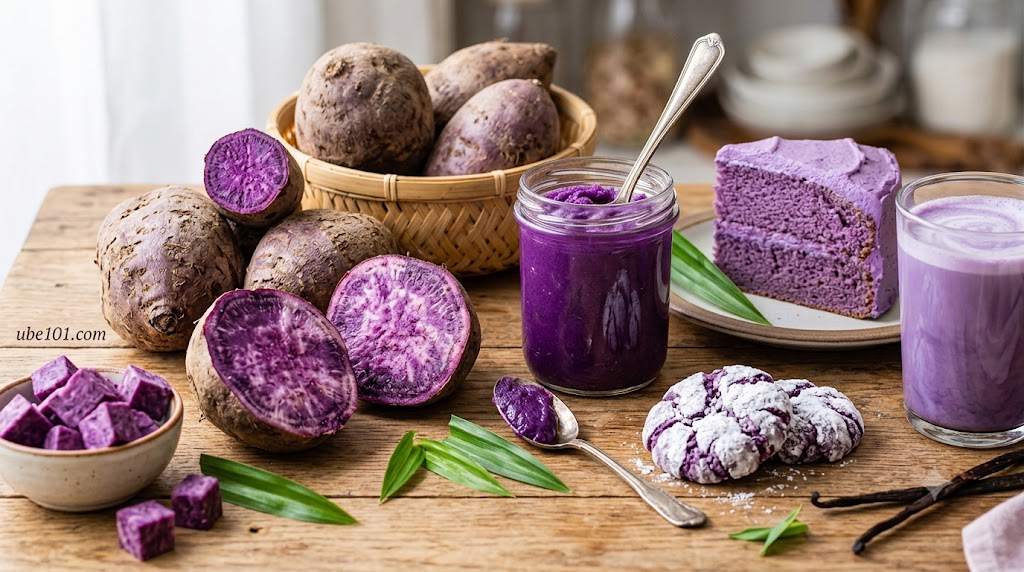
A friend of mine tried ube ice cream for the first time last summer and asked me point blank, “wait, is this just dyed vanilla?” I get that question a lot. Ube looks so intensely purple that people assume someone’s playing tricks with food coloring. Nobody’s tricking anyone. That color and that flavor both come straight from the plant itself, and once you know the full story, ube stops feeling like a trend and starts making a lot more sense.
Ube (pronounced OO-beh) is a purple yam native to the Philippines, scientifically named Dioscorea alata, with a naturally violet flesh and a flavor that’s sweet, nutty, and vanilla-like. It’s a staple in Filipino desserts, most famously ube halaya, and it has worked its way into mainstream American bakeries, coffee shops, and grocery store freezers. By 2026, research showed that one in four Americans knows the word ube, representing a massive shift in global flavor awareness.
Where Ube Actually Comes From
Ube belongs to the Dioscoreaceae family, the true yam family, and it grows as a climbing vine that needs a trellis or support as it spreads. It is native to Southeast Asia, with the Philippines as its primary home, where it has been cultivated for generations. The region of Benguet in the northern Philippines, along with Bicol and the Visayas regions in the south, have particularly strong ube-cultivating traditions.
Unlike sweet potatoes, which are low-growing ground cover plants, ube’s vine climbs upward, and the actual tuber grows deep underground while the plant reaches for support above.
What Ube Actually Tastes Like
Ube tastes sweet, nutty, and floral, with clear notes of vanilla, pistachio, and a hint of white chocolate and coconut. It is far milder than people expect, closer to a warm, toasted nut blend than anything artificial or candy-like.
Nicole Ponseca, owner of two Filipino restaurants in New York, describes it as “an amalgamation of vanilla with the nuttiness of pistachio, gentle rather than intense.” King Arthur Baking describes it as “earthy with a milky flavor reminiscent of white chocolate, notes of coconut, rich nutty pistachio, and aromatic vanilla.”
Raw ube isn’t sweet at all. It is starchy and slightly bitter straight out of the ground due to a protein called dioscorin, which requires heat to break down. Steaming or boiling for 30 to 40 minutes is what unlocks the sweet, creamy flavor associated with the name.
Why It’s So Purple
Ube’s color comes from anthocyanins, natural plant pigments that also show up in blueberries, purple cabbage, and red grapes. Specifically, research points to cyanidin and peonidin as the active pigments in ube.
These pigments carry real antioxidant properties. Studies on purple yams suggest that anthocyanins help reduce inflammation, support heart health, and regulate blood sugar. One surprising fact: ube’s purple color often intensifies when cooked into desserts like ice cream or halaya because the fats in condensed milk and coconut milk help fix and emulsify the natural pigment.
If you want the full breakdown on why the shade shifts so much, our guide on ube color and why it varies covers that in detail.
Ube Nutrition: What’s In It?
Per 100 grams of cooked ube, you get approximately:
- Calories: 120
- Carbohydrates: 27g
- Dietary Fiber: 4g (supports digestive health)
- Protein: 2g
- Vitamins & Minerals: Rich in Vitamin C (roughly 40% of daily value), Vitamin A, potassium (13% of daily value), and manganese.
Importantly, ube has a low glycemic index (GI) of approximately 24, which is significantly lower than white potato (GI ~78) and sweet potato (GI ~63), making it a blood-sugar-friendly starch option.
Ube vs Its Lookalikes
People mix ube up with two other purple root vegetables constantly, so here’s how to tell them apart:
- Purple sweet potato (Ipomoea batatas): Belongs to the morning glory family. It tastes earthier and starchier, closer to a regular sweet potato, and lacks ube’s vanilla-like aroma. It is also much easier to source fresh in the US.
- Taro (Colocasia esculenta): Belongs to the aroid family. It is starchier, nuttier, and much less sweet, with cream-colored flesh speckled with light purple. The bright purple “taro” bubble tea you see in cafes is actually artificially colored (often with ube extract), not the natural color of taro.
| Feature | Ube | Purple Sweet Potato | Taro |
|---|---|---|---|
| Scientific name | Dioscorea alata | Ipomoea batatas | Colocasia esculenta |
| Plant family | True yam (Dioscoreaceae) | Morning glory (Convolvulaceae) | Aroid family (Araceae) |
| Flavor | Sweet, vanilla, pistachio | Earthy, starchy | Nutty, starchy, less sweet |
| Color | Deep violet | Purple to maroon | Light lavender to gray |
| Common use | Desserts | Savory sides, roasting | Both sweet and savory |
The Different Forms You’ll Find Ube In
Since fresh ube is difficult to source outside of Asian grocery stores, home cooks rely on these formats:
- Ube powder: Dehydrated, ground purple yam. It is shelf-stable and excellent for baking once reconstituted with hot water or milk.
- Ube extract: A liquid flavoring concentrate. Popular grocery brands (like McCormick or Butterfly) often contain artificial food coloring alongside real or identical ube flavorings.
- Frozen grated ube: Found in the freezer aisle at Asian markets. This is the closest substitute to fresh ube for baking and cooking.
- Ube halaya (ube jam): A sweet jam made by cooking mashed ube with condensed milk, evaporated milk, butter, and coconut milk. It is the base for almost all Filipino ube desserts.
How Ube Shows Up in Filipino Cooking
Ube halaya sits at the center of Filipino dessert culture. It is eaten on its own or used to fill pastries like ube pandesal (soft bread rolls) and bibingka (coconut rice cakes). It is also layered into sapin-sapin (sticky rice cakes) and serves as a classic topping for halo-halo (the famous shaved ice dessert).
Additionally, ube macapuno (purple yam combined with sweet coconut sport) is a traditional birthday cake flavor across the Philippines, popularized by heritage bakery chains like Goldilocks and Red Ribbon.
Why Ube Took Off in the US
Ube was named the 2024 Flavor of the Year by T. Hasegawa USA, highlighting its transition from a regional favorite to a global culinary trend. This growth was driven by:
- Filipino-American Food Culture: Culinary pioneers and restaurants (like Purple Yam in Brooklyn) introducing heritage desserts to wider audiences.
- Visual Appeal: The striking, naturally vibrant purple color matches the photo-driven nature of modern food culture.
- Mainstream Retailing: Trader Joe’s introducing ube butter mochi cake mix and ube ice cream, while Target, Whole Foods, and King’s Hawaiian (with their ube rolls) brought the flavor to national supermarket shelves.
If you’re curious about the specific chemical compounds behind the taste, our breakdown of ube’s flavor profile goes deeper into the science.
The Bottom Line
Ube is a real, distinct plant with its own history, flavor, and cultural heritage. It is not dyed, it is not a sweet potato, and it only unlocks its signature sweet, vanilla-pistachio taste once cooked. Whether you use fresh yam, powder, or a jar of halaya, understanding its characteristics makes it easier to respect and cook with this incredible purple root.
References
- Datassential. What Is Ube and Why Is It So Popular? Datassential Menu Trends, 2026.
- PR Newswire. T. Hasegawa Names Ube the 2024 Flavor of the Year. December 2023.
- King Arthur Baking. Your Guide to Baking With Ube. May 2024.
- Healthline. 7 Benefits of Purple Yam (Ube), and How It Differs from Taro. Healthline Nutrition Research.
- Food Network. What Is Ube? Origins, Flavor, and Recipes. May 2024.
- Fine Dining Lovers. What Is Ube? Flavor, Uses, and Culinary Origins. October 2025.
- NutriScan. Ube (Purple Yam): Calories, Glycemic Index, and Nutrition. 2026.
