
This article is not available in this language yet
We haven't translated this guide into your selected language yet, but you can read the full original article in English.
Read Article in EnglishFoire aux questions
How do you pronounce ube?
Ube is pronounced OO-beh. The first syllable rhymes with "boot" and the second syllable sounds like the "beh" in "bed." It is a two-syllable word with equal stress on both syllables.
Is ube pronounced "yoo-bee"?
No. "Yoo-bee" is the most common mispronunciation. English speakers default to the English long-u sound, but ube is a Tagalog word where "u" is always pronounced "oo" as in "boot."
Where does the word ube come from?
The word "ube" comes from Tagalog, the primary language of the Philippines. It traces back to the Proto-Austronesian term *qubi*, reflecting the ingredient's deep roots in Southeast Asian agriculture and food culture dating back thousands of years.
Is it "OO-beh" or "OO-bee"?
"OO-beh" is the standard Tagalog pronunciation and the most widely accepted version. Some Filipino speakers from Visayan-speaking regions may say "OO-bee." Both are generally understood, but "OO-beh" is the version used by most Filipino food professionals and media.
Why is ube so hard to pronounce?
Ube is hard for English speakers because the word does not follow English spelling conventions. In English, "u" at the start of a word usually sounds like "yoo," and short words are often one syllable. Ube breaks both of those patterns because it follows Tagalog phonetic rules instead.
What language is the word ube?
Ube is a Tagalog word. Tagalog is the primary language of the Philippines and the basis for Filipino, the national language. In Tagalog, vowels are always pronounced consistently, which is why "u" sounds like "oo" and "e" sounds like "eh."
How do you say ube halaya?
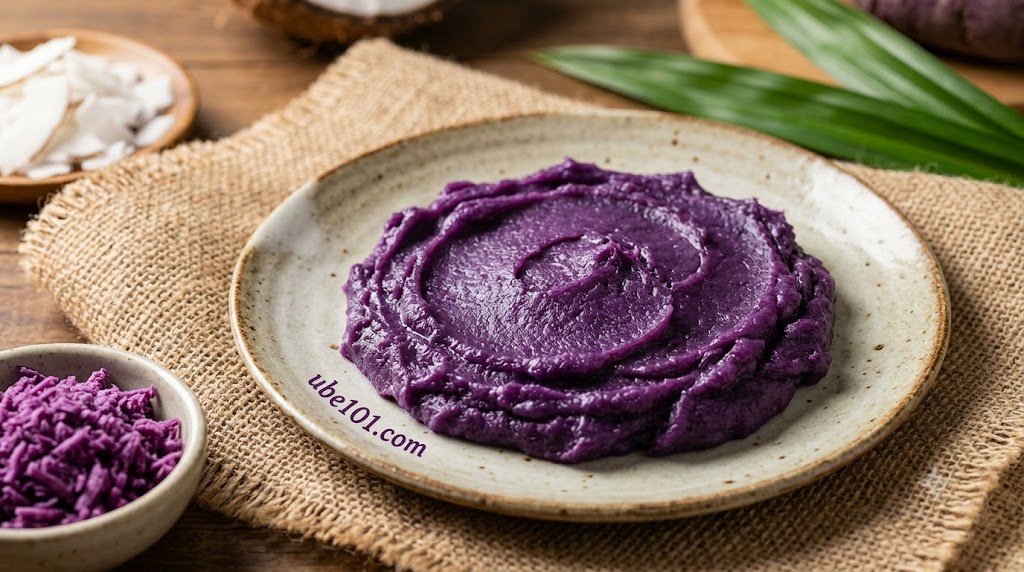
Ube halaya is pronounced "OO-beh hah-LAH-yah." The stress in "halaya" falls on the second syllable. Ube halaya is a thick, sweet jam made from purple yam, coconut milk, and condensed milk.
Is ube and purple yam pronounced the same way?
"Purple yam" is the English common name for ube and is pronounced using standard English. "Ube" is the Tagalog name and is pronounced OO-beh. They refer to the same ingredient (Dioscorea alata), but the pronunciations follow different language rules.
Does the pronunciation of ube vary by country?
In the Philippines, the standard pronunciation is OO-beh, with minor regional variations. Outside the Philippines, mispronunciations are common because speakers apply their native language's phonetic rules to the Tagalog word.
What is the easiest way to remember how to pronounce ube?
Think: "OO (like boot) + beh (like bet)." Say it three times quickly and it sticks. Some people also remember it as "oo" plus "beh," which sounds almost like saying "who? bay?" quickly but with a short "eh" at the end instead of a long "ay."