
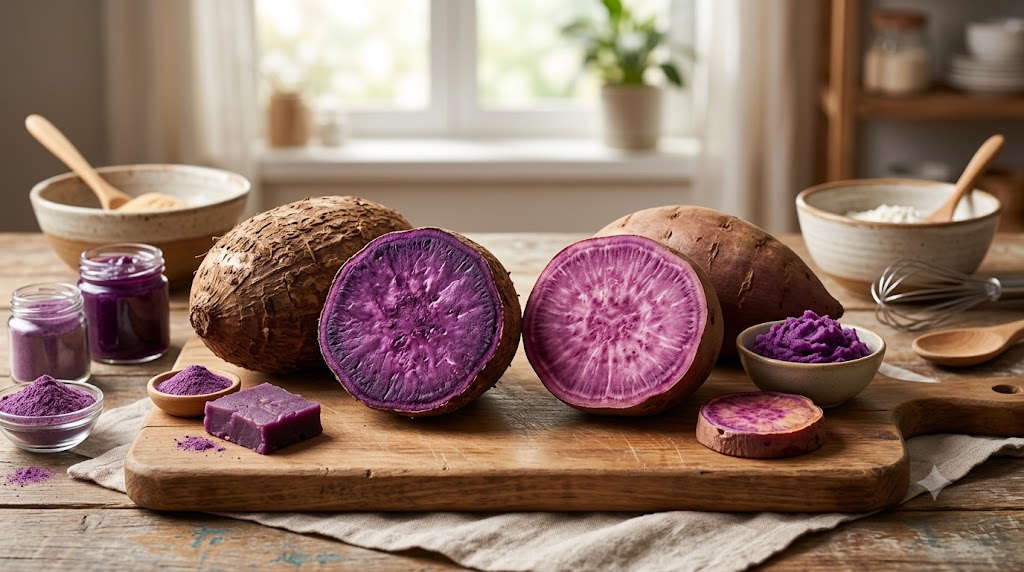
A home baker posted a photo in a Filipino cooking group last year. Her halaya had turned gray instead of purple, and she couldn’t figure out why. Turns out she’d grabbed “purple sweet potato” off her grocery shelf, not real ube. The two look almost identical in the produce aisle, so honestly, who could blame her? This mix up happens all the time, and even grocery stores get it wrong on their labels.
Ube and purple sweet potato are two separate plants. Ube (Dioscorea alata) is a true yam from Southeast Asia. Purple sweet potato (Ipomoea batatas) is a root vegetable from Central and South America. They share a purple color and a bit of sweetness, but that’s about where the similarities stop.
Two Different Plant Families, Not Just Two Colors
Ube sits in the Dioscoreaceae family. Purple sweet potato belongs to Convolvulaceae, the same family as morning glory flowers. That’s not a minor technical detail. It means these two tubers are about as closely related as a fig is to a tomato.
Ube grows as a climbing vine and needs something to wrap around as it grows. Purple sweet potato spreads low along the ground instead. Ube comes from the Philippines and nearby parts of Southeast Asia. Purple sweet potato traces back to tropical Central and South America, with a cultivation history stretching back roughly 4,500 years.
The word “yam” adds its own layer of confusion here in the US. Grocery stores label plenty of orange sweet potatoes as “yams,” and that’s not accurate either. A real yam, like ube, has rough, bark like skin and a totally different growth pattern than any sweet potato.
Taste and Texture Tell the Real Story
If you’ve tried both side by side, you already know. Ube tastes sweet, nutty, and a little like vanilla. Purple sweet potato leans earthier and starchier, closer to what a regular sweet potato tastes like, just tinted purple.
Ube also holds more moisture than purple sweet potato, and that moisture changes everything once you start baking with it. Mash ube and it turns into a smooth, almost custard like paste. Mash purple sweet potato and it holds its shape more and dries out faster.
Ube’s starch content runs about 25% higher than purple sweet potato’s, and that’s a big part of why Filipino bakers reach for it in creamy desserts without needing extra thickeners.
The Purple Isn’t the Same Purple
Both tubers get their color from anthocyanins, the plant pigments that also show up in blueberries and red cabbage. Purple sweet potatoes carry high antioxidant activity from these compounds, sometimes on par with blueberries and other antioxidant rich fruits, according to research from the USDA’s Agricultural Research Service.
Even so, the shades don’t match. Ube tends to hold a brighter, more violet color that stays consistent through baking and freezing. Purple sweet potato often leans toward a deeper blue purple or maroon, and the shade shifts depending on the specific variety. A lot of neon purple “ube” desserts you see online are getting help from food dye rather than the actual yam.
Can You Swap One For the Other?
Yes, in a pinch, but you’ll taste the difference. Purple sweet potato works fine in savory dishes or as a side, and it can stand in for ube if that’s all you’ve got. What you lose is the vanilla nutty flavor and the creamy texture that makes ube desserts like halaya or ube ice cream so distinct. Swap purple sweet potato into a recipe built around real ube, and the color survives but the flavor and texture won’t quite land the same.
Side by Side Comparison
| Feature | Ube | Purple Sweet Potato |
|---|---|---|
| Scientific name | Dioscorea alata | Ipomoea batatas |
| Plant family | Dioscoreaceae (true yam) | Convolvulaceae (morning glory) |
| Origin | Southeast Asia | Central and South America |
| Growth habit | Climbing vine | Low, trailing vine |
| Flavor | Sweet, nutty, vanilla like | Earthy, starchy, sweet |
| Texture cooked | Creamy, custard like | Drier, holds its shape |
| Color | Bright violet, holds through cooking | Deep purple to maroon, varies by type |
| Common uses | Halaya, ice cream, cakes, lattes | Roasting, mashing, savory sides |
Spotting the Difference at the Store
Check the skin first. Ube has rough, bark like, irregular skin. Purple sweet potato has smoother, thinner skin, either light brown for the Stokes Purple variety or beige for the Okinawan type. Stokes Purple got patented in the mid 2000s and shows up with thin, light to medium brown skin. Okinawan sweet potato dates back to 17th century Japan and usually wears beige skin, known there as beni imo.
If you’re buying frozen or powdered products, flip the package and read the ingredient list. Dioscorea alata means real ube. Ipomoea batatas means you’re holding purple sweet potato, no matter what the front of the bag claims.
Want the full story on ube itself, past just this comparison? Check out our [complete guide to what ube is].
Real Ube Products Worth Grabbing
If you want the actual flavor and color instead of a stand in, here are a few real ube products on Amazon:
- Jans Ube Powder for Baking, 5 oz, made from real purple yam, works well in cakes, drinks, and frosting.
- MIKI’S Ube Powder 100g, Philippine Ube, a smaller batch sourced straight from the Philippines, good for bubble tea and desserts.
- Bionutricia Ube Purple Yam Extract Powder 20:1, 7oz, a concentrated extract that works nicely in lattes, puddings, and baking.
The Takeaway
Ube and purple sweet potato share a color and a rough sweetness, and that’s where it ends. Ube is a true yam with a nutty, vanilla like flavor and a creamy texture that carries entire Filipino dessert traditions. Purple sweet potato is a completely different plant, earthier and starchier, better suited to a roasting pan than a mixing bowl full of halaya. If a recipe calls for real ube, real ube gives you something no substitute quite matches. Check the skin, check the label, and you’ll know exactly what’s in your cart before it ever reaches the pan.
Looking for more ways to put real ube to work at home? Browse our full ube dessert collection on Flavor Advisor for recipes built around the real tuber, not the stand in.
अक्सर पूछे जाने वाले प्रश्न
Is ube a sweet potato?
No. Ube is a true yam (Dioscorea alata) from the Dioscoreaceae family. Sweet potatoes belong to Convolvulaceae. They're different plants with different origins, even though grocery stores sometimes label them the same way.
What's the difference between ube and purple sweet potato taste?
Ube tastes sweet with nutty, vanilla like notes and a smooth, creamy texture. Purple sweet potato tastes earthier and starchier, with a drier texture that holds its shape better once cooked.
Can I use purple sweet potato instead of ube?
Yes, but the result won't match. You'll lose ube's signature vanilla nutty flavor and creamy texture, even if the color still turns out purple.
Why is ube purple?
Ube gets its purple color from anthocyanins, natural plant pigments also found in blueberries and red cabbage. These compounds carry antioxidant properties too.
Is Okinawan sweet potato the same as ube?
No. Okinawan sweet potato is a purple sweet potato variety (Ipomoea batatas), first grown in Okinawa back in the 17th century. Ube is a separate species (Dioscorea alata) native to Southeast Asia.
How can I tell ube and purple sweet potato apart at the store?
Check the skin. Ube has rough, bark like, irregular skin. Purple sweet potato has smoother, thinner skin, either light brown (Stokes Purple) or beige (Okinawan). For packaged goods, check the ingredient label for the Latin name.
Is ube a yam or a sweet potato?
Ube is a true yam, botanically speaking. It's not related to sweet potatoes at all, no matter how often US grocery stores mislabel orange sweet potatoes as yams.
Does ube taste like purple sweet potato?
They're close but not the same. Both taste sweet, but ube leans nuttier and more vanilla forward, and purple sweet potato tastes more like a standard sweet potato with a purple tint.
Why do American stores sell purple sweet potato as ube?
Real ube can be tricky to source consistently in the US, so some stores and brands use purple sweet potato as a stand in because of the matching color, even though flavor and texture don't line up.
What is Stokes Purple sweet potato?
Stokes Purple is a specific purple sweet potato variety patented in the mid 2000s. It has thin, light to medium brown skin and vivid purple flesh that darkens further once cooked.