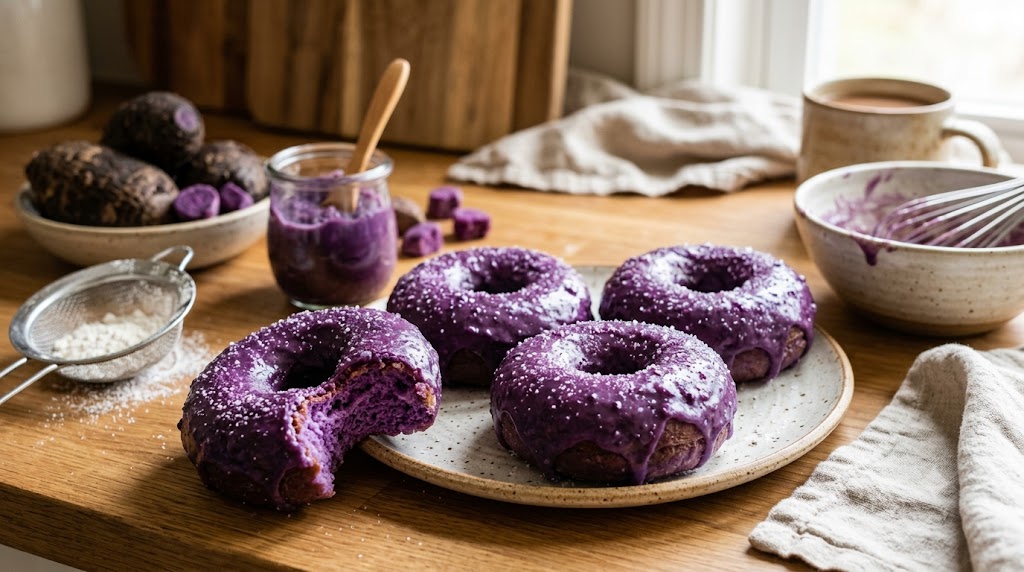
If you were going to design a food specifically for the social media era, you might accidentally design ube donuts. They are vivid purple. They are universally recognizable as something unusual. They taste better than they have any right to based on appearance alone. And they come with a backstory, Filipino culinary heritage, that makes them more interesting than your average glazed ring.
Ube donuts have been appearing on menus at bakeries across the U.S. since around 2018, and they show no signs of slowing down. According to Datassential, ube grew 231% on U.S. menus over four years, and donuts were one of the primary vehicles for that growth.
Quick answer: Ube donuts are donuts flavored with ube (Filipino purple yam), typically through ube glaze, ube cream filling, or ube-flavored dough. They are vivid purple, taste mildly sweet and creamy with vanilla-nutty notes, and are one of the most photogenic ube foods available. The best versions use real ube or ube halaya rather than just food coloring.
What Do Ube Donuts Taste Like?
An ube donut tastes like a well-made donut with a layer of warm, vanilla-nutty sweetness that you cannot place at first bite but immediately enjoy. The ube flavor in a glaze is more subtle than ube in a cake or ice cream because the glaze is thin and the donut itself is the dominant flavor. In a cream-filled ube donut, you get a more concentrated ube experience, particularly when the cream is made with real ube halaya.
The most honest description: if you love a maple-glazed donut for its warm sweetness and the way it contrasts with the fried dough, ube glaze gives you a similar experience but softer, lighter, and more floral.
Types of Ube Donuts
Ube glazed donuts: The most common form. A standard yeast-raised or cake donut with an ube glaze, typically made from powdered sugar, ube extract, and a small amount of milk or cream. The glaze is what is purple. The donut underneath is standard.
Ube cream-filled donuts: A round donut injected with ube-flavored cream filling, usually made from ube halaya mixed with whipped cream or pastry cream. This version has the most concentrated ube flavor.
Ube dough donuts: The donut itself is made with ube in the dough, creating a purple interior. Often coated with an ube glaze for double impact. These are more labor-intensive and more impressive.

Ube mochi donuts: A Japanese-Filipino fusion concept where the donut is made from glutinous rice flour (mochi) rather than regular donut dough. Vegan donuts are sometimes made from mochi base with ube flavoring. These have a chewy interior reminiscent of mochi and a distinct texture from standard fried donuts.
Where to Find Ube Donuts Near You
Manila Social Club in New York City was one of the early popularizers of the ube donut in the American market. Their ube glazed donuts helped bring the concept from Filipino bakeries to a wider audience.
In Los Angeles, Brooklyn, the San Francisco Bay Area, and other cities with significant Filipino-American communities, local Filipino bakeries and Asian fusion dessert shops often carry ube donuts. Donut chains have begun offering ube as a limited-time glaze flavor in markets where ube has a following.
For making ube donuts at home, the glaze is the easiest starting point. Mix powdered sugar with ube extract, a teaspoon of milk, and food coloring if you want a deeper purple, then drizzle over your favorite baked or fried donut recipe.
Key Takeaways
Ube donuts are one of the most accessible and shareable ube desserts. The best ones use real ube halaya in the filling or glaze rather than just food coloring. They taste mildly sweet, creamy, and vanilla-nutty. Look for them at Filipino bakeries, Asian fusion dessert shops, and specialty donut shops in cities with Filipino communities. For more ube dessert guides, visit Ube 101.
