
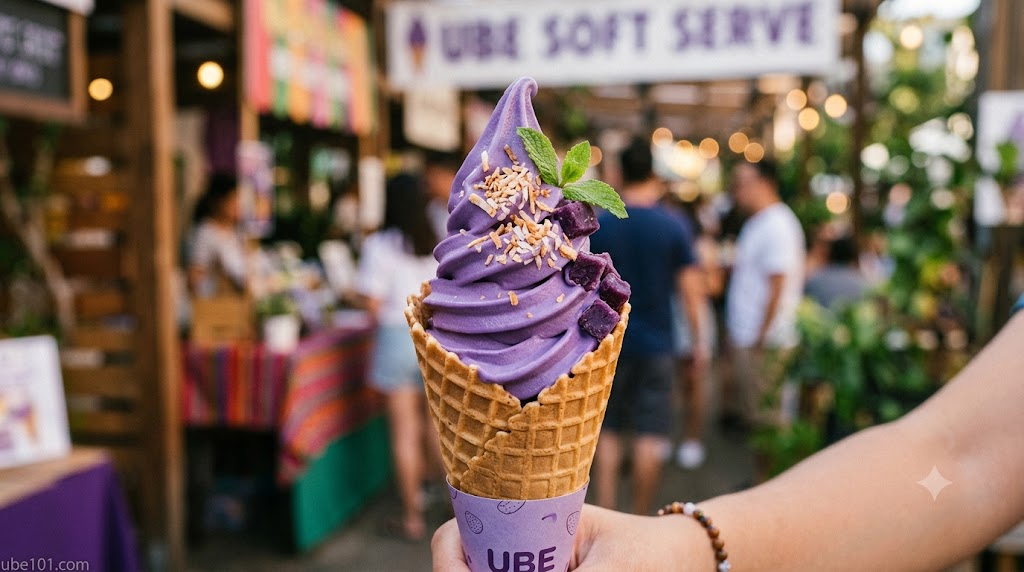
You see it before you taste it. A swirl of deep purple coming out of the machine, curling into a cone or a cup, with a color that makes every other soft serve flavor in the shop look washed out. Ube soft serve has that effect. It stops people mid-walk at dessert shops, not because the color is artificial-looking, but because it is such a specific, natural shade of violet that it does not register as typical ice cream. Then you taste it, and the flavor confirms what the color promised: this is not a gimmick. It is a real, earthy, vanilla-adjacent flavor that comes from a real root vegetable, and it works in the soft serve format better than almost any other form of ube dessert.
What Is Ube Soft Serve?
Ube soft serve is a frozen dessert made from a soft serve base (typically cream, milk, and sugar) flavored with ube, a purple yam (Dioscorea alata) native to Southeast Asia and a staple in Filipino desserts. The soft serve format churns the base at a warmer temperature than regular ice cream and incorporates more air, producing a lighter, creamier, silkier texture than scooped ube ice cream. The ube flavor comes from ube halaya (purple yam jam), ube extract, ube powder, or commercial ube soft serve mixes.
Ube soft serve sits at the intersection of two food trends: the global rise of Filipino flavors and the soft serve renaissance that has turned what used to be a fast-food afterthought into a craft dessert format. At Ube 101, we cover where to find it, what commercial mixes the shops are using, and how to approximate it at home if you do not live near a shop that serves it.
Where to Find Ube Soft Serve Near Me
Finding ube soft serve near me depends on your location, but the number of shops serving it has grown significantly since 2024. Here is where to look:
Asian dessert cafes and specialty ice cream shops are the most reliable source. Many of the shops that serve matcha soft serve have added ube as a permanent or rotating flavor. In major cities, you can often find both.
Notable shops serving ube soft serve:
| Shop | Location | What they offer |
|---|---|---|
| Soft Swerve | New York City, NY | Ube soft serve as a flagship flavor, swirled with other flavors |
| SoftSpot Ice Cream and Dirty Soda | Multiple locations | Ube soft serve with various toppings |
| Matcha Cafe Maiko | Multiple U.S. locations | Ube as a rotating seasonal flavor |
| UBAE | Hawaii and select West Coast locations | Dedicated ube dessert cafe |
Filipino bakeries and dessert shops in cities with large Filipino communities (Los Angeles, San Francisco Bay Area, Chicago, Houston, Las Vegas, Virginia Beach) often serve ube soft serve or ube ice cream that can be served soft.
Mochi donut shops that feature ube-flavored donuts sometimes also serve ube soft serve as a complementary menu item.
How to search: Google Maps with the query “ube soft serve near me” will surface the closest options. Yelp and Instagram are also useful for finding shops, since ube soft serve is one of the most photographed desserts and shops that serve it tend to have a strong visual social media presence.
Ube Soft Serve Mix: What the Shops Use
Most shops that serve ube soft serve use a commercial mix rather than making it from scratch. Two brands dominate the market:
Angel Specialty Products produces a powdered ube soft serve mix that is designed for commercial soft serve machines. The mix is combined with water or milk in the machine’s hopper and churned to the right consistency. Angel Specialty is a Filipino company that supplies a wide range of ube-flavored food service products.
Cappuccino Supreme offers an ube-flavored soft serve mix powder that is popular with smaller dessert shops and food trucks. It dissolves in milk and produces a smooth, evenly colored soft serve.
Both mixes produce a soft serve with a uniform purple color and a sweet, ube-adjacent flavor. The flavor from commercial mixes tends to be milder and sweeter than what you would get from using real ube halaya, because the mixes rely on ube flavoring rather than real purple yam puree.
Can you buy these mixes for home use? Technically, yes. Both are available through food service suppliers and occasionally on Amazon or eBay. But they are formulated for commercial machines that churn at specific speeds and temperatures. Using them in a home ice cream maker or Ninja Creami will produce acceptable results but not the exact same texture as what you get from a soft serve machine.
How to Make Ube Soft Serve at Home
You do not need a commercial machine to get close to the soft serve experience. Here are three approaches, ranked from simplest to most equipment-intensive.
Method 1: Frozen banana base (no machine needed)
This is the quickest path to something that looks and feels like soft serve. Peel and freeze 3 ripe bananas (cut into chunks before freezing). Add them to a food processor with 2 tablespoons ube halaya, 1/2 teaspoon ube extract, and 2 tablespoons coconut milk. Process until smooth and creamy, scraping down the sides as needed. Serve immediately.
The texture is light and scoopable, similar to soft serve. The banana flavor is present but not overwhelming, especially when the ube extract is added. This method is also naturally dairy-free, which makes it a good option for vegan ube soft serve.
Method 2: No-churn base (freezer method)
Whip 2 cups of heavy cream to stiff peaks. Fold in 1 can (14 oz) sweetened condensed milk, 1/3 cup ube halaya, and 1 teaspoon ube extract. Pour into a shallow, freezer-safe container and freeze for 2 to 3 hours (not the full 6 to 8 hours you would use for regular ice cream). At the 2 to 3 hour mark, the mixture should be soft enough to scoop with a spoon but firm enough to hold its shape, similar to soft serve.
This method requires some timing. If you freeze it too long, it becomes regular ice cream. Pull it out at the right stage and you get a texture that is remarkably close to what comes out of a machine.
Method 3: Ice cream maker or Ninja Creami
If you own an ice cream maker, prepare a standard ice cream base (cream, milk, sugar, egg yolks cooked into a custard), add ube halaya and ube extract, and churn according to the machine’s instructions. The churned ice cream should come out at a soft serve consistency. Eat it immediately or transfer to the freezer.
For a Ninja Creami, combine sweetened condensed milk, heavy cream, whole milk, ube halaya, and ube extract in the pint container. Freeze for 24 hours, then run the ice cream cycle. The result is smooth, airy, and very close to commercial soft serve in texture.
Products for homemade ube soft serve (affiliate links):
Butterfly Ube Flavoring Extract on Amazon: Butterfly Ube Flavoring Extract 2 oz
Sari Foods Ube Powder on Amazon: Sari Foods Co Natural Non-GMO Ube Purple Yam Powder
Dairy-Free Ube Soft Serve
Making dairy-free ube soft serve is straightforward because ube’s flavor pairs naturally with coconut, which is the best dairy-free base for frozen desserts.
Coconut cream base: Use 1 can (13.5 oz) full-fat coconut cream (refrigerated overnight and scooped out without the liquid), 1/3 cup maple syrup or sugar, 1/4 cup ube halaya, and 1 teaspoon ube extract. Whip the coconut cream until fluffy, fold in the other ingredients, and freeze for 2 to 3 hours for a soft serve consistency.
Oat milk base: Blend 2 cups of oat milk with 1/3 cup sugar, 1/4 cup ube halaya, 1 teaspoon ube extract, and 1 tablespoon cornstarch. Heat until the mixture thickens slightly, cool completely, then churn in an ice cream maker or freeze and process in a Ninja Creami.
The coconut cream version produces the richest texture. The oat milk version is lighter and slightly icier but still very good.
Ube Soft Serve vs. Ube Ice Cream: What Is the Difference?
| Factor | Ube soft serve | Ube ice cream |
|---|---|---|
| Serving temperature | About 21°F (warmer) | About 10°F (colder) |
| Air content (overrun) | 30% to 60% | 15% to 25% |
| Texture | Light, smooth, silky | Dense, rich, scoopable |
| Fat content | Generally lower | Generally higher |
| Best served | Immediately from the machine | After 6+ hours of freezing |
| Shelf stability | Melts quickly | Holds shape longer |
The higher air content in soft serve is what gives it that light, mousse-like quality. It melts faster than regular ice cream, which is why soft serve shops serve it in cups or cones rather than pints. The ube flavor comes through more gently in soft serve because the lighter texture does not coat the tongue as heavily as dense ice cream does.
Best Toppings for Ube Soft Serve
Ube soft serve pairs well with toppings that complement its earthy, sweet flavor without overwhelming it:
Toasted coconut flakes add crunch and enhance the subtle coconut note already present in ube. This is the most natural pairing.
Mochi bites (small pieces of chewy rice cake) add a textural contrast that works well with the smooth, airy soft serve.
Condensed milk drizzle is the Filipino move. A thin stream of sweetened condensed milk over ube soft serve adds richness without changing the flavor profile.
Crushed graham crackers provide a buttery crunch that cuts through the creaminess.
Ube crinkle cookie crumbles double down on the ube flavor and add a fudgy texture.
Mango or jackfruit pieces add tropical fruit brightness that pairs well with ube’s earthy warmth.
Why Ube Soft Serve Is Having Its Moment
Ube soft serve is growing because of three converging factors. First, ube itself has gone mainstream. The global ube ice cream market was valued at approximately USD 1.24 billion in 2025 (source: Growth Market Reports), and that growth is spilling over into every frozen ube format including soft serve.
Second, the soft serve format is social media-ready. A swirl of deep purple soft serve in a cone photographs beautifully, and ube’s natural color (which comes from anthocyanin antioxidants in the purple yam) does not need artificial food coloring to look striking on camera.
Third, the craft soft serve trend has elevated the format from fast food to specialty dessert. Shops like Soft Swerve in NYC and SoftSpot have shown that soft serve can be a destination dessert, not just a drive-through afterthought. Ube is one of the flavors that benefits most from this shift because its flavor profile (subtle, earthy, complex) rewards the higher quality bases and fresher ingredients that craft shops use.
Nutritionally, the ube in soft serve brings some real value. A 100-gram serving of cooked ube provides about 140 calories, 3 to 4 grams of fiber, and meaningful amounts of vitamin C and potassium (source: Healthline). The anthocyanins that give it its purple color have been linked to anti-inflammatory effects in published research (source: National Institutes of Health, PubMed Central). The soft serve itself is still a dessert with added sugar and cream, but the base ingredient is more nutritious than what goes into most ice cream flavors.
If ube soft serve is not available in your area yet, the homemade methods above will get you close. And for more on the flavor behind the purple, check out our guide to what ube tastes like and our ube near me directory.
Frequently Asked Questions About Ube Soft Serve
What does ube soft serve taste like? Ube soft serve tastes mildly sweet with earthy, nutty undertones, similar to vanilla mixed with pistachio. The soft serve format makes it lighter and creamier than scooped ube ice cream. The flavor is warm and comforting, not sharp or fruity.
Where can I find ube soft serve near me? Search Google Maps for “ube soft serve near me” or “Filipino dessert shop near me.” Asian dessert cafes, mochi donut shops, and Filipino bakeries are the most likely sources. Shops like Soft Swerve in New York City specialize in ube soft serve. Check Instagram and Yelp for local options.
Is ube soft serve dairy free? Most commercial ube soft serve contains dairy. Some shops offer dairy-free versions made with coconut milk or oat milk. If you are making it at home, you can use full-fat coconut cream as a base for a dairy-free version that still has a rich, creamy texture.
Can I make ube soft serve without a machine? You can make a soft serve-style consistency at home by blending frozen bananas with ube halaya and a splash of coconut milk in a food processor. The result is not technically soft serve (it lacks the air incorporation of a machine), but the texture is similar and it can be eaten immediately.
What is ube soft serve mix? Ube soft serve mix is a powdered or liquid base designed for commercial soft serve machines. Brands like Angel Specialty Products and Cappuccino Supreme sell ube-flavored mixes that are added to the machine’s hopper with water or milk. These mixes are primarily sold to businesses, not home users.
How is ube soft serve different from ube ice cream? Soft serve is churned at a higher temperature and has more air incorporated, making it lighter and smoother than scooped ice cream. Ube soft serve has a creamier, silkier mouthfeel compared to the denser texture of traditional ube ice cream.
Can I use ube powder to make soft serve? Yes. Rehydrate ube powder with warm milk to form a paste, then add it to your soft serve base before churning or freezing. Use about 2 tablespoons of powder per batch. Ube powder provides color and flavor, but adding a small amount of ube extract will intensify the aroma.
Is ube soft serve available at Costco or Trader Joe’s? As of 2026, neither Costco nor Trader Joe’s sells a dedicated ube soft serve product. Trader Joe’s carries seasonal ube ice cream (not soft serve), and Costco occasionally stocks ube-flavored frozen desserts. For actual soft serve, look for specialty dessert shops.
What toppings go best with ube soft serve? Toasted coconut flakes, mochi bites, crushed graham crackers, macapuno (coconut sport), condensed milk drizzle, and ube crinkle cookie crumbles all pair well. Mango and jackfruit also complement the flavor.
How many calories are in ube soft serve? A typical serving (about 1/2 cup or one cone) contains approximately 150 to 200 calories, depending on the base used and toppings added. This is comparable to vanilla soft serve. The ube itself adds minimal extra calories but provides anthocyanin antioxidants.
SEO Metadata
- Title tag: Ube Soft Serve: Where to Find It, How to Make It
- Meta description: Find ube soft serve near you or make it at home. Covers top shops, commercial mixes, DIY methods, and dairy-free options.
- URL slug: ube-soft-serve
- Excerpt: Ube soft serve blends the earthy, vanilla-like flavor of Filipino purple yam into a light, creamy frozen treat. This guide covers where to find it, what mixes shops use, and three ways to make ube soft serve at home.
References
- Healthline. “Purple Yam (Ube): Nutrition, Benefits, and Uses.” https://www.healthline.com/nutrition/purple-yam
- National Institutes of Health, PubMed Central. Research on anthocyanins in Dioscorea alata. https://pubmed.ncbi.nlm.nih.gov/
- Growth Market Reports. “Ube Ice Cream Market Size, Share & Trends.” https://growthmarketreports.com/
- Wikipedia. “Dioscorea alata.” https://en.wikipedia.org/wiki/Dioscorea_alata
প্রায়শই জিজ্ঞাসিত প্রশ্নাবলী
What does ube soft serve taste like?
Ube soft serve tastes mildly sweet with earthy, nutty undertones, similar to vanilla mixed with pistachio. The soft serve format makes it lighter and creamier than scooped ube ice cream. The flavor is warm and comforting, not sharp or fruity.
Where can I find ube soft serve near me?
Search Google Maps for 'ube soft serve near me' or 'Filipino dessert shop near me.' Asian dessert cafes, mochi donut shops, and Filipino bakeries are the most likely sources. Shops like Soft Swerve in New York City specialize in ube soft serve. Check Instagram and Yelp for local options.
Is ube soft serve dairy free?
Most commercial ube soft serve contains dairy. Some shops offer dairy-free versions made with coconut milk or oat milk. If you are making it at home, you can use full-fat coconut cream as a base for a dairy-free version that still has a rich, creamy texture.
Can I make ube soft serve without a machine?
You can make a soft serve-style consistency at home by blending frozen bananas with ube halaya and a splash of coconut milk in a food processor. The result is not technically soft serve (it lacks the air incorporation of a machine), but the texture is similar and it can be eaten immediately.
What is ube soft serve mix?
Ube soft serve mix is a powdered or liquid base designed for commercial soft serve machines. Brands like Angel Specialty Products and Cappuccino Supreme sell ube-flavored mixes that are added to the machine's hopper with water or milk. These mixes are primarily sold to businesses, not home users.
How is ube soft serve different from ube ice cream?
Soft serve is churned at a higher temperature and has more air incorporated, making it lighter and smoother than scooped ice cream. Ube soft serve has a creamier, silkier mouthfeel compared to the denser texture of traditional ube ice cream.
Can I use ube powder to make soft serve?
Yes. Rehydrate ube powder with warm milk to form a paste, then add it to your soft serve base before churning or freezing. Use about 2 tablespoons of powder per batch. Ube powder provides color and flavor, but adding a small amount of ube extract will intensify the aroma.
Is ube soft serve available at Costco or Trader Joe's?
As of 2026, neither Costco nor Trader Joe's sells a dedicated ube soft serve product. Trader Joe's carries seasonal ube ice cream (not soft serve), and Costco occasionally stocks ube-flavored frozen desserts. For actual soft serve, look for specialty dessert shops.
What toppings go best with ube soft serve?
Toasted coconut flakes, mochi bites, crushed graham crackers, macapuno (coconut sport), condensed milk drizzle, and ube crinkle cookie crumbles all pair well with ube soft serve. Mango and jackfruit also complement the flavor.
How many calories are in ube soft serve?
A typical serving of ube soft serve (about 1/2 cup or one cone) contains approximately 150 to 200 calories, depending on the base used and toppings added. This is comparable to vanilla soft serve. The ube itself adds minimal extra calories but provides anthocyanin antioxidants.