
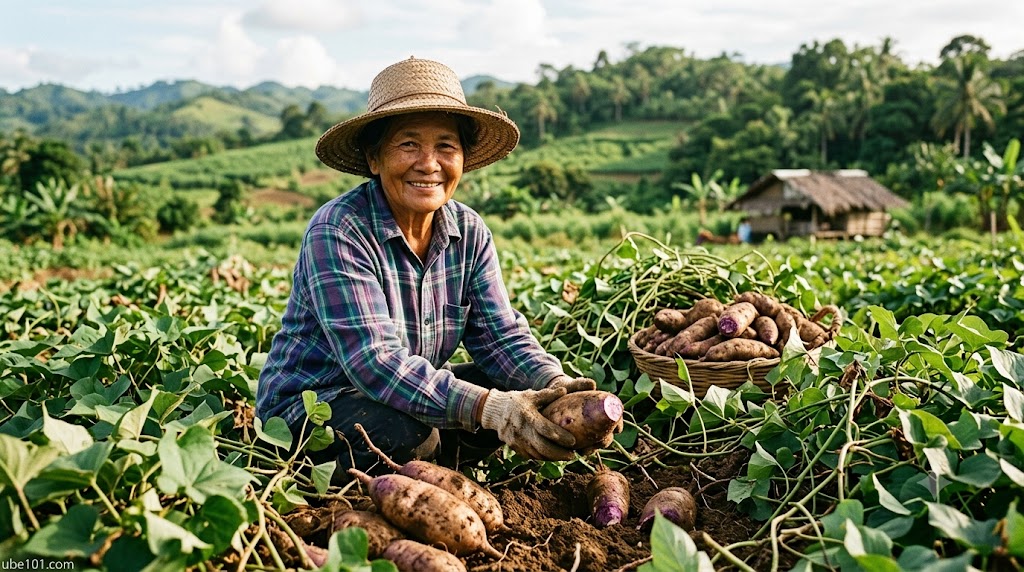
A few years ago, a farmer in Sablan, Benguet told a reporter from ABS-CBN something that stuck with me. He said his family had been growing ube for three generations, and for most of that time, nobody outside the province cared. Now, suddenly, everyone wants it, and there is barely enough to go around.
That tension sits at the center of the ube story in the Philippines. The purple yam that took over American Instagram feeds and Starbucks menus in 2025 and 2026 has been part of Filipino life for thousands of years. At Ube 101, we write about ube from every angle, but this article is about where it all started and why that origin matters more than most people realize.
Ube (Dioscorea alata) is a true yam native to Southeast Asia, with the Philippines serving as one of its primary centers of cultivation. Filipinos have grown and eaten ube for thousands of years, turning it into halaya, halo-halo, and dozens of other traditional foods long before it became a global trend. The word “ube” itself comes from Tagalog and traces back to the Proto-Austronesian term qubi, which tells you just how far back this plant goes in the region’s agricultural history.
What Is Ube and Where Does It Originally Come From?
Ube is a starchy tuber with naturally deep purple flesh, classified botanically as Dioscorea alata. It belongs to the Dioscoreaceae family, making it a true yam (not a sweet potato, not taro). The plant produces large, irregularly shaped underground tubers that can weigh anywhere from a few hundred grams to several kilograms.
The species originated in Southeast Asia and the Pacific Islands. Researchers at institutions like the Visayas State University (VSU) in Leyte have documented that Dioscorea alata has been cultivated in the Philippine archipelago for thousands of years. Archaeological and linguistic evidence supports this. The Tagalog word “ube” descends from the Proto-Austronesian qubi, a term that spread across the Pacific with ancient migration patterns.
Inside the Philippines, ube grows in several regions. The Cordillera Administrative Region (including Benguet province), the Bicol region, and parts of the Visayas are all known for ube farming. Each area has its own local varieties. Benguet State University’s Northern Philippines Root Crops Research and Training Center (NPRCRTC) has cataloged multiple cultivars, including Kinampay, Zambal, Mindoro, Sampero, and Padihot, each with slightly different color intensity, starch content, and flavor.
Why Ube Is More Than a Food Trend in the Philippines
For Filipinos, ube is not a trendy ingredient that showed up on TikTok. It is a food with deep connections to family, celebration, and cultural identity.
Ube halaya, the thick jam made by cooking mashed purple yam with coconut milk, condensed milk, and butter, is the anchor of this tradition. Making halaya from scratch is labor-intensive work. You peel, boil, mash, and then stir the mixture over heat for 30 to 60 minutes, sometimes longer. That kind of time investment means halaya is typically made for occasions that matter: fiestas, birthdays, family reunions, and holiday gatherings.
The tradition of ube in Filipino food goes well beyond halaya. Ube is a staple in kakanin (traditional Filipino rice cakes and sweets). It shows up in halo-halo, the layered shaved ice dessert that is sometimes called the unofficial national dessert of the Philippines. It fills hopia (a flaky pastry). It colors and flavors pandesal (Filipino bread rolls), ensaymada (soft butter buns), and dozens of regional variations.
When you eat ube at a Filipino gathering, you are eating something that carries the weight of generations of cooking. That context tends to get lost when the same ingredient shows up in an American coffee chain’s seasonal menu.
The Ube History Philippines Timeline
Tracking the exact timeline of ube in the Philippines involves both archaeological evidence and colonial-era food records.
Dioscorea alata has been present in the Philippine archipelago since long before recorded history, part of the broader Austronesian agricultural tradition that spread across the Pacific. The earliest European accounts of Philippine food, from the Spanish colonial period starting in the 1500s, mention root crops that match the description of ube being cultivated and traded among local communities.
The transformation of ube from a simple boiled root into the flavored jam (halaya) we know today happened gradually. Coconut milk was always available locally, but condensed milk and butter arrived during the American colonial period in the early 1900s. That combination of local and introduced ingredients gave birth to the modern ube halaya recipe.
By the mid-20th century, Filipino bakeries like Goldilocks (founded in 1966) and Red Ribbon had standardized ube cakes and pastries as part of their product lines, spreading ube from home kitchens into commercial bakeries across the country.
Where Ube Grows in the Philippines Today
The Philippines remains one of the world’s primary sources of ube, though the production picture is more complicated than most people assume.
According to data from the Philippine Statistics Authority (PSA), national ube production has actually declined in recent years, falling from over 14,000 metric tons in 2021 to approximately 12,483 metric tons in 2025. That decline happened while global demand for ube was spiking, creating a supply gap that forced Filipino processors to begin importing frozen ube from Vietnam.
The production drop has several causes. Farmers in regions like Benguet often sell their entire harvest for immediate profit rather than saving tubers for next season’s planting material. Climate instability, including droughts and unpredictable rainfall, also hurts yields. And the fragmented nature of smallholder farming in the Philippines makes it difficult to scale production to meet the kind of volume that international demand requires.
Benguet State University’s NPRCRTC has been working to address these problems through techniques like aeroponics for seed production and minisett technology that helps farmers propagate planting material more efficiently. The Department of Agriculture has also explored Geographical Indication (GI) protection for premium varieties like Bohol’s Ubi Kinampay, which could help Filipino farmers capture more value from their crop.
Ube’s Nutritional Profile and Health Properties
Ube’s appeal goes beyond color and flavor. The purple pigment comes from anthocyanins, the same class of antioxidant compounds found in blueberries and purple cabbage. Research published in the National Institutes of Health (NIH) and Frontiers in Nutrition has documented that the anthocyanins in Dioscorea alata are highly stable and show significant antioxidant and anti-inflammatory activity.
Per 100 grams of cooked purple yam, typical nutritional values include approximately 140 calories, 27 grams of carbohydrates (including resistant starch), 3 to 4 grams of fiber, and meaningful amounts of Vitamin C (up to 40% of daily value) and potassium (approximately 13.5% of daily value), according to data compiled by Healthline from USDA sources.
The glycemic index of ube is relatively low, typically between 35 and 41, which means it releases glucose into the bloodstream more slowly than many other starchy foods. Research from the Philippines’ Department of Science and Technology (DOST) has shown that purple yam anthocyanins exhibit antioxidant activity comparable to standard antioxidants like alpha-tocopherol (a form of Vitamin E).
The Philippines Ube Export Market
The global appetite for ube has turned it into an export commodity. In 2025, the Philippines exported approximately 1.7 million kilograms of ube and ube-based products, valued at around $3.06 million to $3.2 million, according to reporting from the Philippine Star and Inquirer.net.
Major export destinations include the United States, Canada, South Korea, and parts of Europe. Most of this export volume moves as frozen grated ube, ube powder, or processed ube halaya. Fresh ube is difficult to export because the tubers are perishable and heavy.
The export market represents both an opportunity and a challenge. Higher international prices can benefit Filipino farmers, but only if they can actually access those markets. Right now, much of the export value is captured by processors and intermediaries rather than by the smallholder farmers who grow the crop.
For a detailed look at how ube products are used in the U.S. market, see our guide on where to buy ube.
How Ube Became a Global Food Phenomenon
The timeline of ube going global starts with the Filipino-American community.
Filipino immigrants brought ube recipes and ingredients to the United States throughout the 20th century. Filipino bakeries and grocery stores in cities like Los Angeles, New York, and the San Francisco Bay Area kept ube desserts available for decades, mostly within Filipino communities.
The crossover moment started around 2015 to 2017, when food bloggers and Instagram accounts began posting photos of ube’s naturally striking purple color. The visual appeal drove curiosity, and that curiosity turned into demand. By 2024, T. Hasegawa USA, one of the top ten food and beverage flavor manufacturers in the world, named ube its Flavor of the Year. Datassential reported that ube grew 231% on U.S. menus over a four-year period.
By 2026, Starbucks launched ube drinks across the U.S. market, Trader Joe’s expanded its seasonal ube product lineup, and ube had become a recognizable ingredient far beyond Filipino communities.
Through all of that growth, the source of ube remains the same: the fields of the Philippines, where farmers are still growing the same species their families have cultivated for generations.
What Makes Filipino Ube Different from Other Purple Yams
Not all purple tubers are ube. This distinction matters because several different plants get labeled “purple yam” in international markets.
True Filipino ube (Dioscorea alata) has a specific flavor profile that sets it apart: mildly sweet, gently nutty, with vanilla-like notes and a subtle earthiness. That flavor develops fully when the ube is cooked and processed into halaya, where coconut milk and condensed milk amplify its natural characteristics.
Purple sweet potato (Ipomoea batatas) is a completely different species. It tastes earthier and less sweet than ube, and it lacks the creamy, vanilla quality that makes ube so distinctive in desserts. Taro (Colocasia esculenta) is yet another plant entirely, with white or cream-colored flesh and a mild, starchy flavor nothing like ube.
The specific growing conditions in the Philippines (tropical climate, volcanic soil in many regions, and traditional cultivation practices) contribute to the flavor and anthocyanin content of Filipino ube. Varieties like Kinampay from Bohol are considered premium specifically because of their intense purple color and rich flavor.
The Bottom Line
Ube’s story starts and stays in the Philippines. It is a food with thousands of years of cultivation history, deep cultural significance in Filipino celebrations and family cooking, and a nutritional profile that modern science continues to validate. The current global demand for ube creates real economic opportunities for Filipino farmers, but also real challenges around supply, fair pricing, and cultural credit.
If you are eating ube, you are eating something that connects you to one of the oldest and richest food traditions in Southeast Asia. That context makes every bite a little more meaningful.
For a full breakdown of what ube actually tastes like and how its flavor compares to similar ingredients, check out our what does ube taste like guide on Ube 101.
SEO Metadata
Title tag: Ube Philippines: Origin, History, Culture Meta description: Ube has been part of Filipino food culture for thousands of years. Here is the real story of where ube comes from and why it matters. URL slug: ube-philippines Excerpt: Ube is not just a trendy purple ingredient. It is a Filipino food with thousands of years of history, deep cultural roots, and a production story that most people never hear about. Here is the full picture.
References:
- Philippine Statistics Authority. Yam production data (2021-2025).
- Benguet State University, Northern Philippines Root Crops Research and Training Center (NPRCRTC).
- Visayas State University (VSU), Leyte. Root crop research documentation.
- Department of Science and Technology (DOST), Philippines. Anthocyanin antioxidant research.
- Healthline. “7 Benefits of Purple Yam (Ube).” healthline.com.
- National Institutes of Health (NIH). Dioscorea alata anthocyanin bioactivity studies.
- Frontiers in Nutrition. Purple yam polyphenol research (2024-2025).
- Philippine Star. “Philippines ube export market data.” philstar.com. 2025.
- Inquirer.net. “Ube supply challenges and Vietnam imports.” inquirer.net. 2025.
- VeraFiles. “Ube farming and propagation challenges.” verafiles.org.
Pertanyaan yang Sering Diajukan
Where does ube originally come from?
Ube (Dioscorea alata) is native to Southeast Asia and the Pacific Islands. The Philippines is one of its primary centers of cultivation, where it has been grown for thousands of years. The word "ube" comes from Tagalog and traces back to the Proto-Austronesian term *qubi*.
Is ube only found in the Philippines?
No. Dioscorea alata grows across Southeast Asia, the Pacific Islands, and parts of Africa. The Philippines is not the only country that cultivates it, but it is one of the primary sources and has the deepest culinary tradition around the ingredient.
What does ube taste like?
Ube has a mildly sweet, nutty, vanilla-like flavor with a gentle earthiness. The flavor is subtle in raw form and develops fully when ube is cooked into halaya with coconut milk, condensed milk, and butter.
Why is ube purple?
The purple color comes from anthocyanins, a class of antioxidant pigments also found in blueberries and purple cabbage. These pigments are naturally present in the flesh of the tuber and become more intense with certain varieties and growing conditions.
What is ube halaya?
Ube halaya is a traditional Filipino jam made from mashed purple yam cooked with coconut milk, evaporated milk, condensed milk, butter, and sugar. It is the base ingredient for most Filipino ube desserts, including cakes, ice cream, and pastries.
How much ube does the Philippines produce?
According to the Philippine Statistics Authority, national ube production was approximately 12,483 metric tons in 2025, down from over 14,000 metric tons in 2021. The decline is caused by planting material shortages, climate impacts, and fragmented smallholder farming.
Does the Philippines export ube?
Yes. In 2025, the Philippines exported approximately 1.7 million kilograms of ube and ube-based products, valued at around $3 million. Major export destinations include the United States, Canada, South Korea, and parts of Europe.
What is kakanin and how does ube fit in?
Kakanin refers to traditional Filipino rice cakes and sweets. Ube is a common flavoring and coloring ingredient in many kakanin preparations, adding its characteristic purple color and gentle sweetness to these traditional treats.
Is ube the same as taro?
No. Ube (Dioscorea alata) and taro (Colocasia esculenta) are completely different plants from different botanical families. Ube is naturally deep purple and sweet. Taro is naturally pale and has a mild, starchy flavor. They are not interchangeable.
Why is ube production declining in the Philippines?
The main factors are a shortage of planting material (farmers sell entire harvests rather than saving seed tubers), climate instability affecting yields, and the fragmented structure of smallholder farming that limits scaling. The Philippines has actually begun importing frozen ube from Vietnam to meet processing demand.