
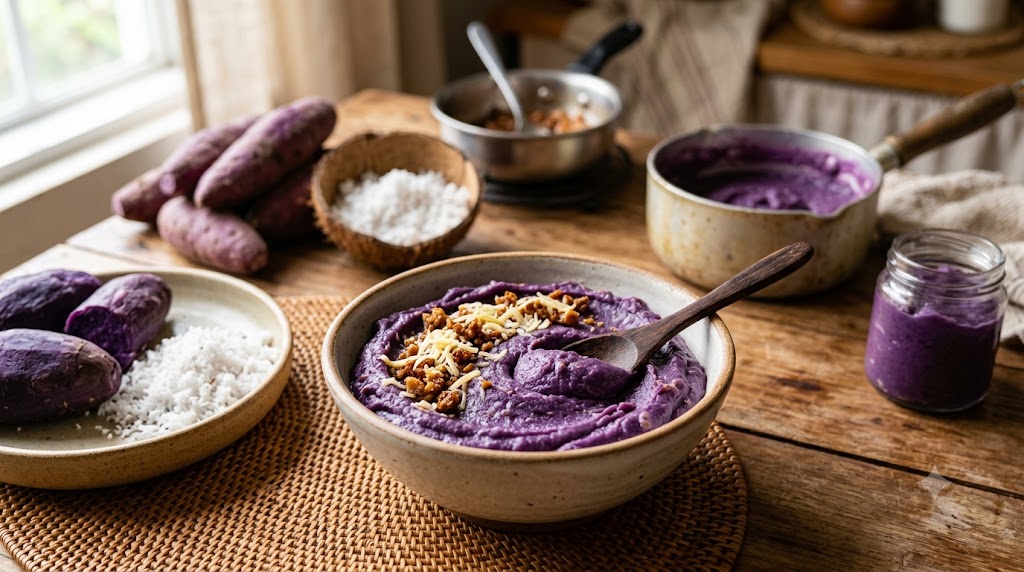
Before ube became a global food trend, before the purple lattes and the Instagram-worthy doughnuts and the Trader Joe’s freezer section full of purple things, there was ube halaya.
It is one of the oldest and most important Filipino desserts. Families have made it for generations. It appears at Christmas Eve tables, at fiestas, at graduation parties, at Sunday family dinners. And for most Filipinos, it is the taste of home.
Ube halaya (also spelled halayang ube, and also called ube jam or purple yam jam) is a thick, creamy, deeply purple jam made from boiled purple yam cooked down with condensed milk, coconut milk, butter, and sugar until it becomes a rich, spreadable paste. The word halaya comes from the Spanish word “jalea,” meaning jelly or jam. The dish likely developed during the Spanish colonial period in the Philippines, when European cooking techniques were adapted to local ingredients.
Quick definition: Ube halaya is a traditional Filipino dessert and ingredient made from mashed ube (Dioscorea alata, purple yam) cooked with condensed milk, evaporated milk, coconut milk, butter, and sugar until thick and creamy. It is sweet, slightly nutty, and deeply purple. It serves as both a standalone dessert and as a base ingredient in countless other Filipino sweets.
What Does Ube Halaya Taste Like?
Ube halaya tastes like the best version of ube possible. On its own, fresh ube has a subtle flavor. But when cooked slowly with condensed milk, butter, and coconut milk, something remarkable happens. The sweetness from the condensed milk amplifies ube’s natural vanilla-nutty notes. The coconut milk brings out a warm tropical aroma. The butter adds richness and a silky finish. The result is a spread that is sweet but not cloying, creamy, faintly nutty, and deeply satisfying.
Think of it as somewhere between a tropical caramel and vanilla pudding, but purple and with an earthiness underneath that reminds you that you are eating something made from a real plant.
Kawaling Pinoy, one of the most trusted sources for traditional Filipino recipes, describes the process as one that requires “religious stirring to prevent from burning at the bottom.” That stirring is not optional. It is what gives ube halaya its smooth, cohesive texture.
The Traditional Ube Halaya Recipe
At its core, making ube halaya requires just a few ingredients and patience. A lot of patience.
The ingredients used across nearly all traditional recipes include: cooked and mashed ube (fresh, frozen, or reconstituted from powder), sweetened condensed milk, evaporated milk, coconut milk, unsalted butter, sugar, and sometimes a small amount of ube extract to deepen the color and flavor.

The process begins with cooking or boiling the ube until fork-tender, then mashing or blending until smooth. Kawaling Pinoy’s recipe recommends combining the mashed ube with all three milks, butter, and sugar in a wide, heavy-bottomed pan over medium heat, then stirring constantly for 30 to 40 minutes until the mixture becomes a thick paste that pulls away from the sides of the pan.
The Unlikely Baker’s version is slightly more minimalist (condensed milk only, no coconut milk) and produces a halaya where the pure ube flavor stands front and center without coconut competing.
Bites by Bianca’s recipe uses a blender first, combining ube with coconut milk and evaporated milk before cooking, resulting in an exceptionally smooth halaya with no fibrous texture.
The common wisdom across all these recipes: do not rush the heat, do not stop stirring, and the drag-through test (dragging your spatula across the bottom of the pan and seeing a clear path that stays open) tells you when it is done.
Store-bought ube halaya, the most commonly available brands being Monika, Goldilocks, and Buenas in Filipino grocery stores and on Amazon, is a reliable, convenient product. It is sweet, purple, and perfectly good for most uses. The texture is consistent and the flavor delivers what you expect.
Homemade ube halaya has more depth. When you make it with good-quality frozen ube or fresh ube, the flavor is more complex and more genuinely ube-forward. The coconut notes are more present. The texture is creamier and less uniform, which sounds like a negative but actually means more interesting.
If you have access to a Filipino grocery and 45 minutes to stand at a stove stirring, homemade is worth doing at least once. For regular weeknight use, store-bought works perfectly.
How to Use Ube Halaya
Ube halaya is one of the most versatile Filipino ingredients because it bridges the gap between a standalone dessert and a baking ingredient.
As a standalone dessert: Eat it cold with a spoon. Serve it on a platter topped with grated cheese or latik (toasted coconut curds). Traditional Filipino halaya is often served this way at holidays and celebrations.
On toast or bread: Spread it on pandesal or sourdough toast. The vanilla-coconut sweetness works beautifully against toasted bread.
As a cake filling: Spread a thin layer between cake layers before adding whipped cream or buttercream frosting. This is how Goldilocks and Red Ribbon use it in their ube cakes.
In ice cream: Swirl ube halaya into vanilla or coconut ice cream for a quick homemade ube ice cream. Or use it as the base flavor when making no-churn ice cream.
In halo-halo: The iconic Filipino shaved ice dessert uses ube halaya as one of its key components, adding sweetness and color alongside coconut, sweet beans, and condensed milk.
In cookies and baked goods: Swirl ube halaya into cookie dough, use it as a filling for ube crinkle cookies, stuff it into cream puffs, or fold it into ube pancake batter.
In drinks: Stir into warm milk with espresso for an ube latte. Blend into a smoothie with coconut milk for an ube smoothie.
Where to Buy Ube Halaya
Filipino grocery stores (Seafood City, Island Pacific, Fil-Am stores) stock multiple brands of ube halaya year-round. H Mart and 99 Ranch Market carry it in their Filipino or Asian dessert sections.
Trader Joe’s has stocked ube halaya periodically, and when they do it tends to sell quickly.
Amazon stocks several brands including Monika and Goldilocks ube halaya, with delivery usually available.
Weee!, the Asian grocery delivery platform, stocks ube halaya consistently with delivery across most major U.S. metro areas.
For full product comparisons and buying guides for ube halaya and all ube products, visit Ube 101.
Key Takeaways
Ube halaya is the most important ube preparation in Filipino cuisine. It is a sweet, creamy, deeply purple jam made from purple yam, condensed milk, coconut milk, and butter. Homemade beats store-bought on flavor but store-bought is convenient and reliable. It works as a dessert on its own, a cake filling, a toast spread, a smoothie ingredient, and a baking flavor. If you are going to cook with ube in any form, ube halaya is where you start.
References
- Kawaling Pinoy. “Halayang Ube (Purple Yam Jam).” kawalingpinoy.com. July 2024.
- The Unlikely Baker. “Ube Halaya Recipe (Ube Jam).” theunlikelybaker.com. 2021.
- Bites by Bianca. “Creamy Ube Halaya Recipe.” bitesbybianca.com. June 2024.
- Cooking Therapy. “How to Make Ube Halaya at Home.” cooking-therapy.com. October 2023.
- The Baking Spoon. “Ube Halaya (Purple Yam Jam).” thebakingspoon.com. September 2025.
- Wikipedia. “Ube Cake.” en.wikipedia.org. (Halaya history and usage references.)
よくある質問
What is ube halaya?
Ube halaya is a traditional Filipino dessert and ingredient made from mashed purple yam (ube) cooked with condensed milk, evaporated milk, coconut milk, butter, and sugar until thick and creamy. It is also called ube jam or purple yam jam.
What does ube halaya taste like?
Ube halaya tastes sweet, creamy, and gently nutty with warm vanilla and coconut notes. It is richer and sweeter than plain ube because the condensed milk and coconut milk amplify the ube's natural flavor significantly.
How do you make ube halaya?
Cook mashed ube with condensed milk, evaporated milk, coconut milk, butter, and sugar over medium heat, stirring constantly for 30 to 40 minutes until the mixture thickens and pulls away from the sides of the pan. The consistency when done is thick enough that dragging a spatula through it leaves a clear trail.
What is ube halaya used for?
Ube halaya is used as a dessert spread, cake filling, ice cream base, halo-halo component, cookie filling, and toast topping. It is also used as an ingredient in ube cake, ube pandesal, ube mochi, and many other Filipino-inspired baked goods.
Where can I buy ube halaya?
Ube halaya is available at Filipino grocery stores (Seafood City, Island Pacific), H Mart, 99 Ranch Market, Trader Joe's (periodically), Amazon, and through the Weee! Asian grocery delivery platform.
Is ube halaya the same as ube jam?
Yes. Ube halaya and ube jam are the same thing. "Halaya" comes from the Spanish "jalea" meaning jam.
How long does ube halaya last?
Homemade ube halaya lasts up to 1 week in the refrigerator in an airtight container, or up to 3 months in the freezer. Store-bought versions have preservatives and last longer. Always check the date on store-bought jars.
Can I make ube halaya with ube powder?
Yes. Rehydrate ube powder with hot water at a 1:5 ratio (powder to water) and cook over a stove, stirring until fully rehydrated, before proceeding with the halaya recipe. The result is slightly grainier than fresh or frozen ube but entirely usable.
What is the difference between ube halaya and ube extract?
Ube halaya is a full cooked preparation (mashed ube plus milks, butter, and sugar) that is a sweet, creamy jam. Ube extract is a concentrated liquid flavoring with food coloring added, designed to add flavor and color to recipes. They serve different purposes and one cannot directly substitute for the other.
Does ube halaya contain coconut?
Most traditional recipes include coconut milk as one of the dairy components, which gives it a subtle tropical aroma. Some recipes omit coconut milk for a more pure ube flavor. Check individual recipes or store-bought labels if you need to avoid coconut.